
The AI Advantage is Compounding
Why Being Behind in AI is Getting Worse, Not Better
Enterprise data suggests early AI leaders are compounding their advantage. The gap is widening and accelerating.
The Stakes Are Higher Than You Think
We're now three years into the Generative AI era. In that time, pretty much every organization, large and small, has started to dabble with how AI could impact their business.
However, there's a huge range in how different companies are engaging with AI. Some have nascent experiments or a "DIY posture" that lets employees figure it out themselves. Others have extremely sophisticated, comprehensive org-wide efforts.
The Critical Insight
The stakes for organizations that are starting to lag are even higher than they think. Increasingly, we're seeing how AI advantage compounds. The enterprise AI "rich" get richer, and are likely to grow the gap between them and competitors rather than see it shrink as late adopters try to catch up.
Key Takeaways
- AI advantage compounds: 96% of leaders are seeing productivity gains, and they're reinvesting those gains back into AI, creating a flywheel that late adopters can't catch.
- The usage gap is massive: Frontier workers generate 6x more AI messages and are 17x more active in coding. They're not just doing more. They're doing differently.
- More usage creates non-linear value: Workers using 7 task types save 5x more time than those using 4. The relationship between AI investment and ROI isn't linear. It's exponential.
- Leaders are reinvesting, not cashing out: 47% expand existing AI, 42% develop new capabilities, 39% invest in R&D. Only 17% are reducing headcount.
- The agentic wave will accelerate divergence: Leading organizations are building the infrastructure for autonomous AI. When agents arrive at scale, the compounding advantage will spin even faster.
The Evidence: What Enterprise Surveys Reveal
Recent surveys from OpenAI, EY, and Menlo Ventures paint a consistent picture of AI's measurable business impact.
More Messages from Frontier Workers
Top 5% of adopters generate 6x the median usage
More Active in Coding
Frontier workers vs. median for complex tasks
More Custom GPT Usage
Frontier orgs integrate AI into complex workflows
Growth in Custom GPT Users
Weekly users of custom GPTs and projects
More Intelligence Used
Workers saving 10+ hours/week use 8x more AI
The Usage Gap: Leaders Use AI Differently
OpenAI calls those in the 95th percentile of adoption intensity "frontier workers" and "frontier organizations." These aren't just using AI more. They're using it differently.
What Frontier Organizations Do Differently
More active in analysis and calculations
Moving beyond simple queries to complex analytical work
More active in coding
Using AI for software development and automation
More messages to custom GPTs
Building context-rich repositories for complex workflows
Key insight: As organizations move from simple use to more mature complex use, they move more work to custom GPTs because they become repositories of context and knowledge. About a fifth of all enterprise messages now go through custom GPTs or projects.
More Usage Begets More Value (Non-Linearly)
The relationship between AI usage and value isn't linear. Organizations that use AI across more task types and benefit categories see dramatically higher ROI.
Task Type Multiplier
Workers who engage across more task types report exponentially more time saved:
Time Savings ≠ Highest ROI
The strongest predictors of high ROI are not time savings, but rather:
- Improved decision-making
- New capabilities
- Increased revenue
The Implication for Late Adopters
Organizations stuck at the "time savings" layer (simple productivity gains) are getting differentiated, non-linear ROI disadvantage compared to those moving up the value chain to decision-making, new capabilities, and revenue impact.
The Money Side: Investment Compounds Too
Big Spenders See Big Results
Organizations investing <$10M
52% significant gains
Organizations investing $10M+
71% significant gains
The Reinvestment Flywheel
96% of organizations seeing gains are reinvesting them:
- 47% → Expanding existing AI
- 42% → Developing new AI capabilities
- 39% → R&D investment
- Only 17% reducing headcount
- Only 24% returning capital
The Scariest Part for Late Adopters
Leaders aren't taking profits. They're buying more AI. They're reinvesting 47% of their gains back into AI capabilities, creating a flywheel that makes them impossible to catch.
The Agentic Acceleration Coming Next
According to Menlo Ventures, only 16% of enterprise deployments currently qualify as truly agentic: systems where an LLM plans, executes actions, observes feedback, and adapts behavior. Even those are very simple.
But this is about to change. Leading organizations are building the infrastructure that agents require:
Data organized, ready, accessible
Tool calling wired into system design
Integration with existing systems
Redesigned stacks to support autonomy
Once these leaders can deploy autonomous agents that do bigger, more complex chunks of work, the compounding flywheel that increases their separation from late adopters will spin even faster, and move them even farther ahead.
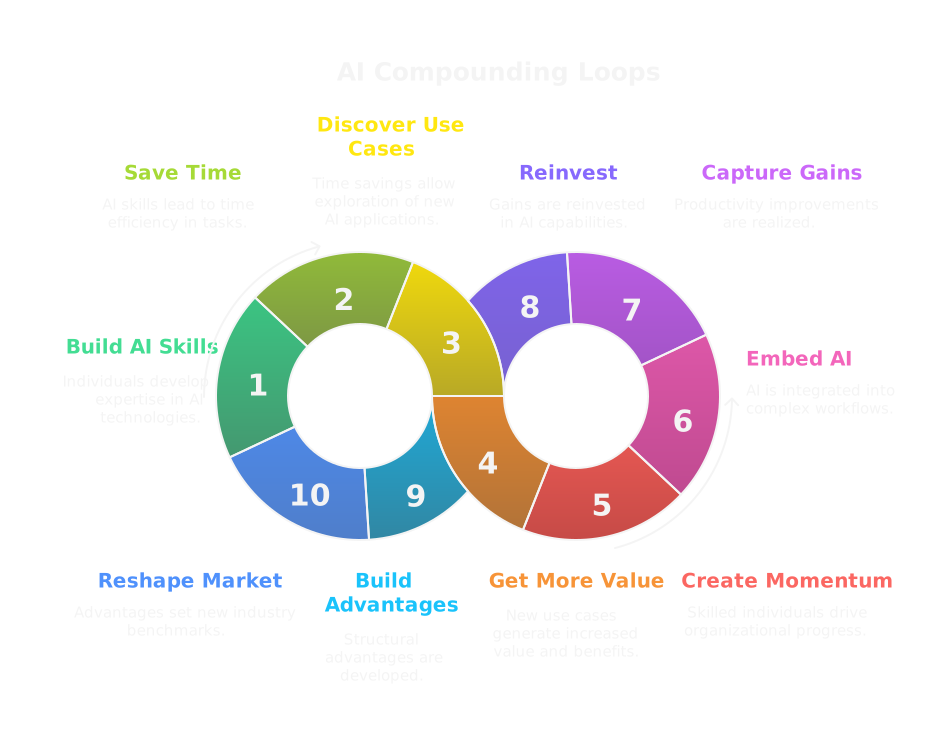
The Three Compounding Loops
Loop 1: Individual Skills
Individuals build AI skills → save time → discover more advanced use cases → get more value → build more skills
Loop 2: Organizational Momentum
Skilled individuals create momentum → embed AI into complex workflows → capture productivity gains → reinvest in capabilities → build structural advantages
Loop 3: Market Reshaping
Structural advantages turn into new benchmarks for current offerings: faster production, more output, lower cost. But it's not just current products.
39% of leading organizations are reinvesting in R&D and 42% in new AI capabilities, creating new product lines that give them revenue advantages, which leads to more investment and a compounding competitive moat.
The Bottom Line
Being behind or ahead in AI is not linear scale.
The organizations that are behind now are likely to get farther behind.
The organizations that are ahead now are likely to get farther ahead.
Good news for the leaders. Very bad news for late adopters.
And it's going to get even more dramatic as leaders increasingly put the infrastructure in place that allows them to fully tap into more autonomous and agentic AI.
Sources
This analysis draws from three major enterprise AI surveys:
OpenAI "State of Enterprise AI | 2025 Report"
View Original ReportEY "AI Pulse Survey" (Wave 4, Dec 2025)
View Press ReleaseMenlo Ventures "State of GenAI in the Enterprise" (3rd Annual)
View ReportDon't Let the Gap Widen
If you find yourself in an AI-constrained organization, now is the time to advocate for more determined and concerted AI efforts. The compounding advantage isn't waiting.
In 20 minutes, we'll assess where your organization stands on the AI maturity curve and identify the highest-impact opportunities to start closing the gap.
Work With Me
I work as a fractional AI lead for a limited number of small and mid-sized businesses at a time. Tell me about your situation and I'll be in touch within 24 hours.
Retainers and the 90-day AI Accelerator available.

What to expect:
- ✓ 20-minute conversation to understand your context
- ✓ Quick assessment of AI opportunities in your operations
- ✓ Honest take on what's worth pursuing (and what's not)
- ✓ No obligation, just clarity on your next steps